
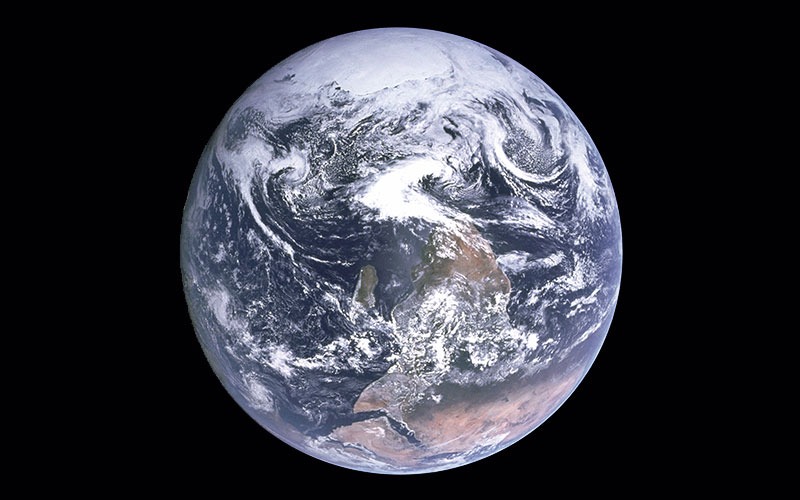
Look at a globe and it's mostly blue. But the five oceans are not one big bathtub. Put their numbers side by side and you get a surprise: the biggest ocean is not the one that matters most for the climate you live in.
Size: the Pacific wins, by a mile
The Pacific covers about 165 million square kilometres. That is more than all the land on Earth put together. The Atlantic follows with about 106 million, then the Indian Ocean with about 70 million. The Southern Ocean around Antarctica has about 22 million, and the Arctic is the baby at about 14 million. You could drop the Arctic into the Pacific more than ten times.
Depth: from 11 km down to "just" 5
The Pacific is also the deepest. Its average depth is around 4,000 metres, and the Challenger Deep in the Mariana Trench drops to about 10,900 metres. Mount Everest would sink there with two kilometres of water to spare. The deepest points of the others: the Atlantic's Puerto Rico Trench at about 8,400 metres, the Southern Ocean's South Sandwich Trench at about 7,400, the Indian Ocean's Java Trench at about 7,200, and the Arctic's Molloy Deep at about 5,550. The Arctic is the shallowest overall, with an average of roughly 1,000 metres.
Temperature: bath water to slush
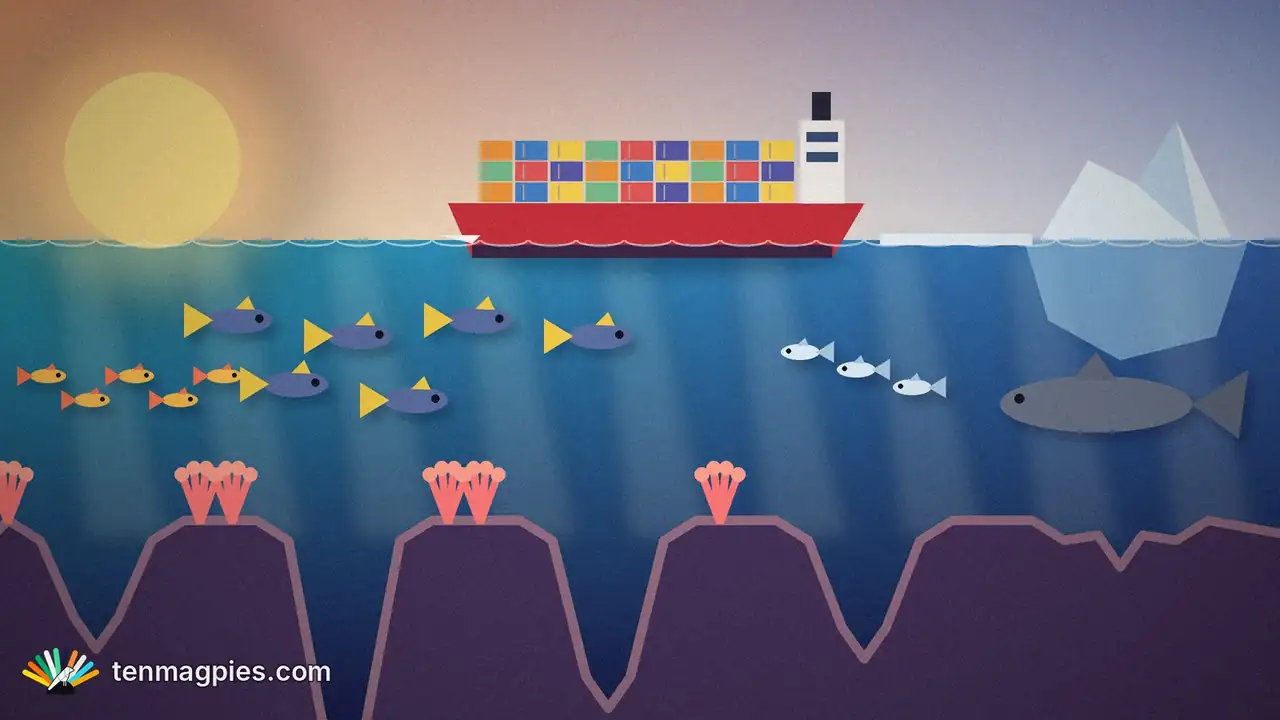
The Indian Ocean is the warmest, with tropical surface water often above 28°C. The Arctic sits close to -1.8°C, the point where seawater freezes. Southern Ocean water stays between about -2°C and 10°C.
Who lives there
More than half of the world's tuna comes from the western and central Pacific. The Atlantic is the home of cod, herring and bluefin tuna. The Indian Ocean hides the coelacanth, a fish once thought to be extinct for 66 million years. The Southern Ocean has icefish with "antifreeze" in their blood, and the Arctic has the Greenland shark, which can live for about 400 years.
Shipping: busy, busier, almost empty
About 80% of world trade by volume travels by sea. The Pacific and Indian oceans carry the giant container routes between Asia, Europe and America, and the Atlantic links Europe with the Americas. The Arctic is still almost empty of cargo ships, and the Southern Ocean sees mostly research vessels and tourist cruises.
Climate: the small ones punch hardest
Here is our take. The oceans have soaked up about 90% of the extra heat from global warming and about a quarter of our CO2. The Pacific's El Niño shakes up weather worldwide, and the Atlantic's Gulf Stream keeps Europe mild. But the two smallest oceans are the alarm bells. The Southern Ocean's current is the strongest on the planet and swallows a big share of that heat and carbon. The Arctic is warming about four times faster than the global average. Watch the small ones.
Source: NOAA, NASA, Encyclopaedia Britannica, Earth-Science Reviews (Five Deeps study), UNCTAD, WCPFC, Science, Communications Earth & Environment
Photo: NASA